Pregnancy is the perfect time for you to quit smoking. You have an excellent reason to quit and the expectance of a new baby should inspire you to rid your body and your home of all the toxins smoking releases. You will feel better and have more energy to go through your pregnancy. You will also reduce your risks of future health problems such as heart disease, cancer and other lung problems.
Facts About Smoking During Pregnancy:When you smoke... so does your baby. When you smoke you inhale poisons such as nicotine and carbon monoxide. These poisons enter into the placenta through your blood, the placenta connects you to your baby and sends oxygen, nutrients, and eliminates wastes. These poisons restrict your baby from getting the proper supply of nutrients and oxygen that your baby needs in order to grow healthily and steadily.
Smoking during pregnancy can cause pre-term delivery, low birth-weight and infant death. Smoking during pregnancy is estimated to account for 20 to 30 percent of low-birth weight babies, up to 14 percent of pre-term deliveries, and about 10 percent of all infant deaths. Smoking during pregnancy or around your baby has been proven to increase the risk of SIDS (Sudden Infant Death Syndrome).
Second hand smoke CAN cause problems for your baby. New studies have shown that if a woman is around second hand smoke during her pregnancy, there are also risks. You have an increased chance of having a baby that is underweight and may have health problems.
There can be long term health risks for your baby. Smoking during pregnancy can cause your baby to have colds more frequently, lung problems, learning disabilities and physical growth problems.
If a mother continues to smoke after her baby is born, the baby may get more colds, coughs and middle-ear infections. Babies have very small lungs and smoking makes it harder for them to breathe. This often causes the baby to get bronchitis and pneumonia.
Nicotine replacement therapy such as the patch can still affect your baby. Before using any nicotine replacement or cessation aids, you should discuss it with your health care provider since nicotine is very harmful to your baby and will still travel through the placenta even if you are just chewing nicotine gum or using a nicotine patch. You and your provider can discuss what is more beneficial for you and your baby since severe nicotine cravings can cause you to become stressed, your body will then release hormones which are also very bad for your unborn baby.
Facts about smoking while breastfeeding: 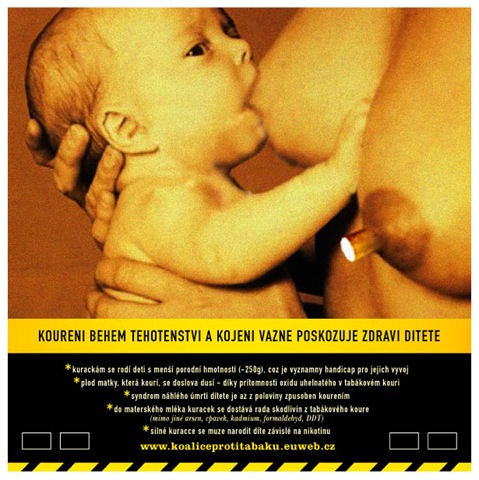
This picture used for a Czech campaign against smoking during pregnancy also suggests that when you smoke your baby smokes, even so it is still healthier for a breastfeeding mother who smokes to continue breastfeeding than for a smoking mother to formula feed. This is because the immunities that are released in your milk help your baby fight illness and can even help counteract some of the effects of cigarette smoke on your baby. Breastfeeding has been shown to decrease the negative effects of cigarette smoke on a baby's lungs. It's definitely better if breastfeeding moms do not smoke, but if you can't stop or cut down, then it is better to smoke and breastfeed than to smoke and formula feed.
The more cigarettes that you smoke, the greater the health risks are for you and your baby. If you can't stop smoking, or don't want to stop smoking, it's safer for your baby if you cut down on the number of cigarettes that you smoke.
What happens to babies when they are exposed to cigarette smoke?
- Babies and children who are exposed to cigarette smoke have a much higher incidence of pneumonia, asthma, ear infections, bronchitis, sinus infections, eye irritation, and croup.
- Colic occurs more often in babies whose mothers or fathers smoke or if a breastfeeding mother smokes. Researchers believe that not only does the nicotine transferred into mother's milk upset baby but the passive smoke in the home acts as an irritant. Babies of smoking parents fuss more, and mothers who smoke may be less able to cope with a colicky baby (due to lower levels of prolactin).
- Heavy smoking by breastfeeding mothers occasionally causes symptoms in the breastfeeding baby such as nausea, vomiting, abdominal cramps and diarrhea.
- Babies of smoking mothers and fathers have a seven times greater chance of dying from sudden infant death syndrome (SIDS).
- Children of smoking parents have two to three times more visits to the doctor, usually from respiratory infections or allergy-related illnesses.
- Children who are exposed to passive smoke in the home have lower blood levels of HDL, the good cholesterol that helps protect against coronary artery disease.
- Children of smoking parents are more likely to become smokers themselves.
- A recent study found that growing up in a home in which two parents smoked could double the child's risk of lung cancer later in life.
How does does smoking affect breastfeeding?
Smoking has been linked to:
- Earlier weaning. One study showed that the heaviest smokers tend to wean the earliest.
- Lower milk production
- Interference with milk let-down
- Lower levels of prolactin. The hormone prolactin must be present for milk synthesis to occur.
- One study indicated that smoking mothers who live in areas of mild to moderate iodine deficiency have less iodine in their breast-milk (needed for baby's thyroid function) compared to non-smoking mothers. The study authors suggested that breastfeeding mothers who smoke should consider taking an iodine supplement.
How to minimize the risk to your baby if you smoke
- The ideal: Stop smoking altogether.
- Cut down. The less you smoke, the smaller the chance that difficulties will arise. The risks increase if you smoke more than 20 cigarettes per day.
- Don't smoke immediately before or during breastfeeding. It will inhibit let-down and is dangerous to your baby.
- Smoke immediately after breastfeeding to cut down on the amount of nicotine in your milk during nursing. Wait as long as possible between smoking and nursing. It takes 95 minutes for half of the nicotine to be eliminated from your body.
- Avoid smoking in the same room with your baby. Even better, smoke outside, away from your baby and other children. Don't allow anyone else to smoke near your baby.

 Some foods can prove to be really harmful to your unborn child or nursing baby. Here are a few foods you should avoid eating when pregnant or breastfeeding.